NEW IPSWICH IN NEW HAMPSHIRE
By Pauline Carrington Bouv�.
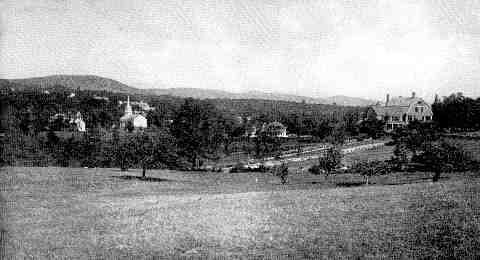
Journeying from the seaboard towards the Connecticut River, upon or near the line between Massachusetts and New Hampshire, three isolated mountain peaks form conspicuous landmarks to the traveller--Watatic, Monadnock and Wachusett. About halfway between the two latter lies the little village of New Ipswich, whose records make an interesting page of New England history.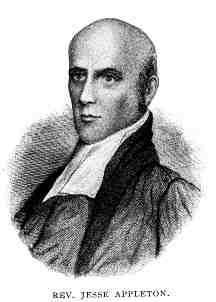 of Massachusetts in the years 1735-6, so that the town of New Ipswich refers to the initial measure of its settlement to this day. That the town of New Ipswich in New Hampshire was named after the town of Ipswich in Massachusetts, to sixty citizens of which latter town the grant, was made the following petition, discovered among the Ipswich records, clearly proves:
"To his Excellency Francis Bernard, Esqr., and to the Honorable his Majesty's Council and to the Honorable House of Representatives in General Court assembled May, 1767. The Petition of Sundry persons Grantees of the Town of New Ipswich, lately so called, and the Legal Representatives of the Grantees of Sd Town. Humbly Sheweth That the Great and General Court or Assembly of the Province of Massachusetts Bay, did, in the month of Jan. Anno Domini 1735, grant unto sixty of the Inhabitants of the Town of Ipswich a Township of the contents of six miles square which was called New Ipswich; that afterwards the said Township fell within the province of New Hampshire; That your Petitioners after having been at a very great and long continued Expence, lost their several rights in said Township, and became Very great Sufferers, they having built a Meeting House, a saw mill, Bridges, &c., besides Expending a great deal on their Several rights; wherefore your Petitioners humbly pray that your Excellency and Honours would be pleased to take the premises into your consideration and grant unto them an Equivalent in some of the ungranted lands of this Province, or make them such other compensation as to your wisdom shall seem meet."Among other signatures to this petition are the names of Isaac Appleton, Samuel Wigglesworth, Nathaniel Rogers and several other men of prominence. The origin of the name Ipswich is a matter of dispute. Some antiquarians believe it to be derived from Eba, a Saxon queen, who lived in the old English town of that name,--wich being of course the Saxon word meaning place or home. Thus Ebaswich was gradually corrupted, they say, into Ipswich. Others claim that the name is derived from the river Gippen, Ipswich being evolved from Gippswich, the place of the Gippen or winding river. however this may be, certainly there is no doubt but that the name of the town comes down from a remote period of Saxon sovereignty in the British Islands.
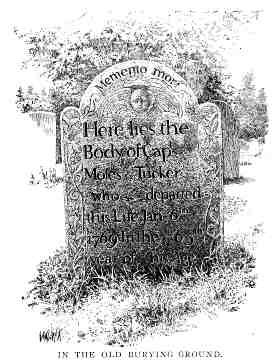
 Benjamin Hoar and Moses Tucker followed Foster; and it was Moses Tucker who in after years remained when the rest of the inhabitants fled before a threatened attack from the Indians. In spite of his neighbors' entreaties, and finally their disgust and ridicule, the valiant Moses fortified himself in his cabin and stayed at home. For some reason the Indians changed their plan of action; and Captain Tucker, as he was called, had the laugh on his side when his neighbors came back.
 men just and true."
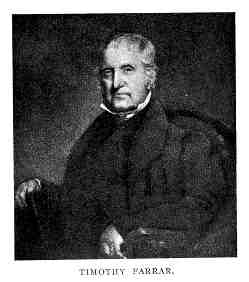 incumbent of the Congregational church, enjoyed the happy distinction--for it was a distinction in those days--of receiving his salary in money. In the musty town records one may read that he was paid annually "40 pounds sterling, together with 40 cords of fire wood," which is suggestive of the very simple needs of that generation. Notwithstanding the quiet simplicity of his way of living, Parson Farrar held as strong an influence over his parishioners as that wielded by any prelate in the pomp of ecclesiastic authority and office. Two of his church members were discussing theology one day.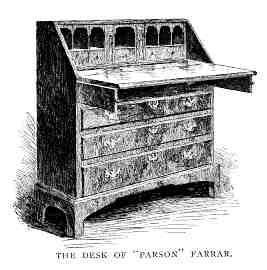
 discourse, in order to learn the meaning of the stranger's advent! Straight up to the judge's pew strode the traveller and whispered: "Your Honor's pardon for this unseemly coming into the Lord's house in such fashion; but the governor of New York bade me find you and announce that the Constitution is ratified, saying: 'Go, stop at New Ipswich and tell Judge Farrar the good news.'" Then, mounting his steed, the envoy clattered off down the dusty highroad. One can imagine the joy of the stately old patriot, who had fought so valiantly for the ratification of the Constitution! The Farrars were of a hale and sturdy race and lived to see many changes in their native town. At the remarkable age of 102 years the judge received a degree from Harvard. The news of this honor reached the old gentleman at night. "Ah," he remarked with quaint humor, "they have stuck a feather in my nightcap!"
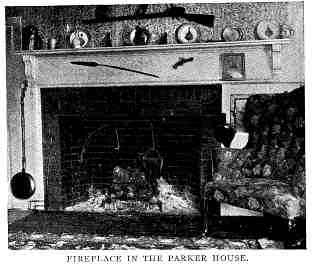
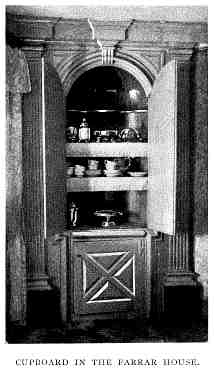 very interesting specimen of colonial country architecture. Its quaint carved cupboards, its crossbeamed ceilings and ancient mouldings are of beautiful workmanship and unique design. One feels a strong desire to poke about in search of secret hiding places in the nooks and corners of the old house.
 stipend. He left two well-know theological works, his "Eschatology," which is a text-book in the New Haven Divinity School, and "The Bible Regained," dedicated to his "beloved and only daughter, Sarah Fiske Lee," herself a genealogist of considerable note. Miss Lee has inherited much of her father's taste for antiquarian research and curio collecting. At the old parsonage or Lee house, the writer was shown a volume which would have set the heart of a bibliomaniac thumping with desire. This precious tome is a huge Bible, the ancient and yellowed title-page of which bears this legend:
 Sixth was ordered to be chained to the reading desks in the churches in England. Unfortunately, a previous owner had had new covers made for the antique volume, so the traces of the chain by which it had been bound were not visible.
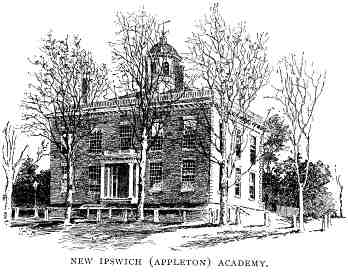
 Sciences, and was also a member of the American Philosophical Society. Jonas Chickering, too, whose name is known to-day all over the world, was born in New Ipswich, where as a boy of nineteen he undertook to tune the first and only piano in the village. Prompted by curiosity and a keen interest in musical instruments, Jonas took this piano, which had grown quite useless for want of repairs, entirely to pieces, and after infinite labor and many qualms of fear on the part of the owner, no doubt, succeeded in restoring it to its pristine tone. This effort was perhaps the mainspring of his ambition to become a piano maker. At all events he soon after came to Boston, and on the day of his arrival secured employment in Osborne's piano factory, at that time the sole one in Boston. This was the second academy incorporated in New Hampshire, Phillips Academy in Exeter having been established and incorporated five years earlier, in 1784. There was a stipulated union between the New Ipswich Academy and Dartmouth College, the Academy students having certain privileges at Dartmouth.1
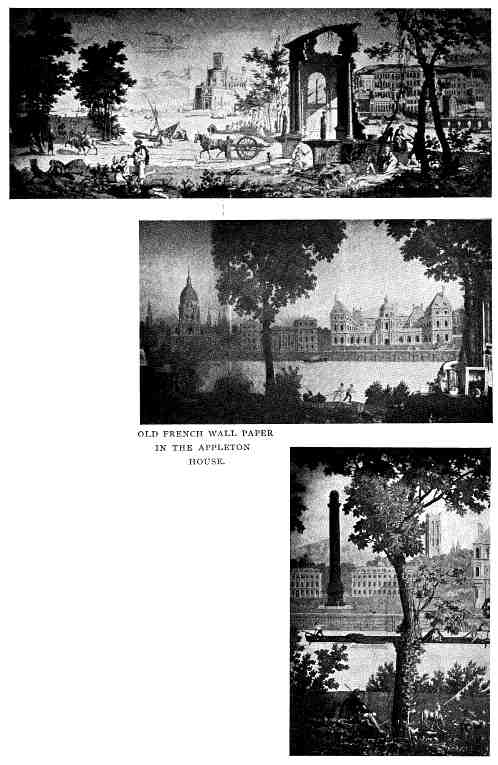
 beautiful, representing scenes on the Seine. The bright green trees reach from floor to ceiling, and the little boats, filled with gay Parisians, seem just ready to glide down the river. This colonial home of the Appletons is used to-day as a sort of hotel, and it is an odd chance that has preserved the quaint French wall paper through the changing vicissitudes of time and conditions.
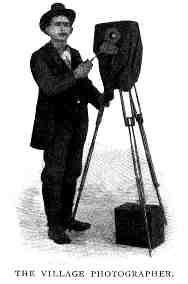 one of the characters of the village. He combines several branches of art and trade in his avocations. In response to some questions in regard to his way of life, he confided to the writer that he was a man of varied pursuits. "I've got four businesses," he remarked one day while taking a snap-shot, "farming, house painting, photography and chicken raisin'; but chickens is the most profitable."
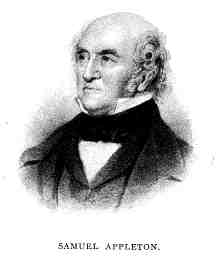
"The story has been told me that some of the young bloods of New Ipswich, four-score years ago, met on a Saturday evening in a schoolhouse for the purpose of card playing. The shutters were closed, the tallow candles lighted, and the young men commenced their deals. Their work went pleasantly till the candle had nearly burned down. One of the party suggested that it was time to close the game so as not to trespass on holy time. Another suggested that the candle would soon burn down and that they would quit; and so, regardless of the flight of time, they kept on playing. The candle continued to burn. Finally they heard carriages passing by. The shutters were opened, and to the astonishment of all, the sun was high in the heavens. Horror seized the young men. They were convinced that the Evil One had kept the candle burning and that they had been lured on to commit the almost unpardonable sin of breaking the Sabbath! This terrible desecration of holy time," continues Miss Lee's correspondent naively, "put an end to card playing during that and future generations of New Ipswich residents."From the magnificent carved pulpit in the old Congregational church, which was a gift from Mr. Samuel Appleton, a broader religion is preached to-day. But the atmosphere of other days and
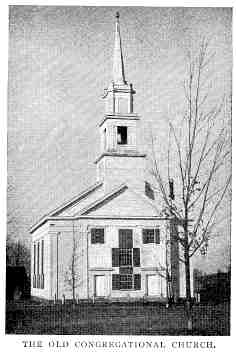 other associations clings to the place. Here the Reverend Jesse Appleton, president of Bowdoin College, sat with his beautiful ascetic young face turned upward in prayerful thought to hear the parson's exhortations; here the Champneys, Prestons, Halls, Barrs, Hartwells, Farrars, and all the pious folk of New Ipswich gathered to hear the Word; and the spot is redolent of the past.
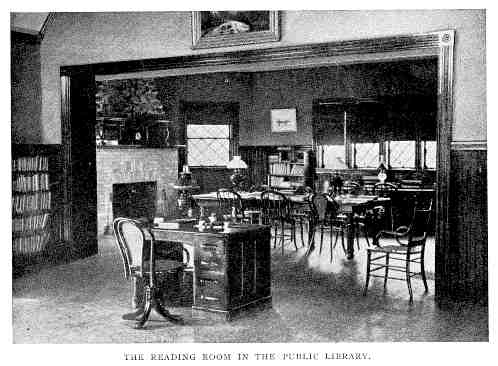 residents. It contains three thousand volumes, a piano, busts of some of our famous authors and many tasteful appointments. Altogether it is an ideal village library, in appearance, management and influence.
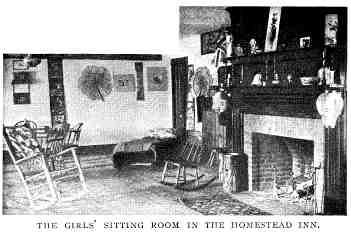
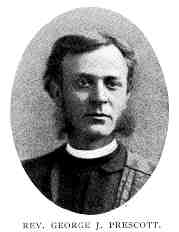 Boston. This institution is "The Homestead Inn," where wearied-out shop girls, and indeed women laborers of all sorts and conditions can get food, lodging, fresh air and restful quiet, for the small sum of three dollars a week. It many cases even this amount is remitted, if it is beyond the means of the applicant. Mr. Prescott conceived the idea of establishing this boarding-house, where plain, wholesome foot and comfortable lodging could be offered to the army of pale faced, worn-out shop girls at a nominal cost. Several ladies of Boston lent their assistance; and about five years ago the "Homestead Inn" became a fact accomplished in New Ipswich. A long, rambling, wood house was purchased, a dormitory built, with little partitions dividing the tiny sleeping apartments, and as many comforts added as the scant amount of money in hand would allow. From the start the institution was successful. Shop girls, dressmakers' apprentices, typewriters, seamstresses, housemaids, cooks and washerwomen found a peaceful refuge at the "Inn." Sometimes women broken in health and spirit, who could not leave home because of children, were taken with their families, though the
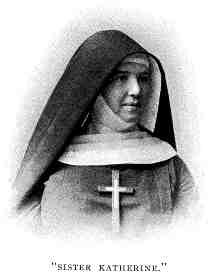
 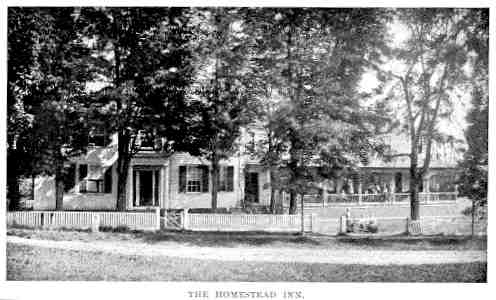 place is particularly for unmarried women. The delicious soft inland air, the scent of pine cones, the generous supply of fresh milk and the abundant, substantial food, soon bring back the color to faded cheeks and dim eyes, and it is common to see bright, refreshed women go back to their work in the city after a two weeks' sojourn at the "Homestead." Sister Katherine, the sister in charge of St. Monica's Home in Boston, goes to the "Inn" in the summer while St. Monica's is closed, and much of the success of the institution is due to her wise management and gentle care. When the curfew rings at sunset and the nine o'clock bell tells that it is bedtime, as it has done for a
  hundred years, the cowled sisters at the "Homestead" say that the bells ring their vespers and nones for them; so ancient puritanism and modern ritual touch, even if they do not mingle, in old New Ipswich.
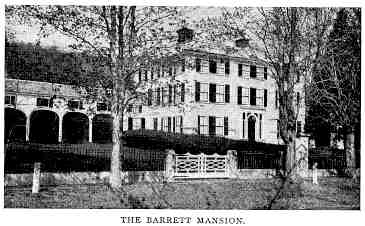
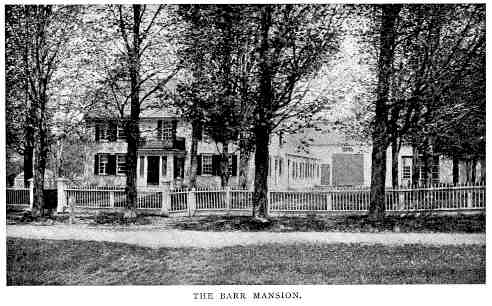
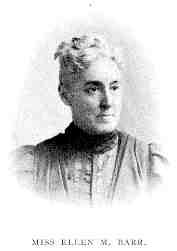
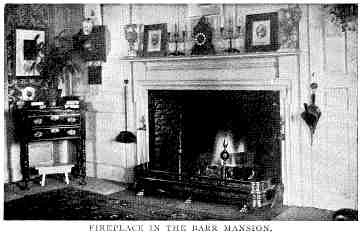
 belongs to the colonial period, dating back to 1768, and has the capacious fireplaces and cosy corners that make houses of that generation so full of delightful surprises. James Barr, a Scotch gentleman, who, while travelling in the American colonies, was caught here when war was declared against Great Britain, fell in love with a bright-eyed New Hampshire maiden and never went back to his Highland home. His son, Dr. James Barr, was a prominent physician in New Ipswich. His sturdy character and genial wit endeared him to all of the Hillsborough folk for miles around. Miss Ellen M. Barr, whose school for girls in Boston for ten years was recognized as one of the best schools ever conducted in Boston, was a native of New Ipswich, the daughter of Dr. James Barr.
  She was born in 1840, and died in 1895. She came to her work in Boston after a successful career as a teacher in the High School in the town of Medford, Massachusetts. Few teachers in New England have had the confidence and admiration of a larger circle of friends. A grandson of Dr. Barr, James Barr Ames, is now dean of the Harvard Law School.
"In the summer of 1849 one of the authors (Frederic Kidder) visited his native town, to repair the tombstones of his ancestors and collect such materials as he might towards a family history. In wandering over the 'old burying-ground' he was struck with the number of the great and good resting there, whose names and deeds were likely soon to be forgotten. On looking over the town records of the period of the Revolution he could not but admire the firm and bold resolves of the citizens, their clear views of republican principles and constitutional liberty, and their self-sacrificing patriotism. He desired that some one should chronicle the history of the town, before the loss of records or the death of the remaining few whose memory extended back to early times should render it too late. After unavailing efforts to prevail on some one to undertake the task, he concluded to attempt it himself."As one turns the pages of a book like this, one realizes anew how much of the real flavor of New England history and life is preserved in such local works. This history of New Ipswich is dedicated appropriately to Samuel Appleton. Two of its dozen and more chapters are devoted to the Revolution, and very vivid pictures they give us of those times that tried men's souls. Here is a graphic passage describing the things which immediately followed the Concord fight:
"By preconcerted arrangements the Committees of Safety in the various towns spread the news in all directions; and so rapidly had messengers sped from town to town, that before nightfall not a place within a hundred miles but had heard the news, and in many instances with almost every kind of exaggeration. The intelligence reached this town about two o'clock in the afternoon; the Committee of Safety immediately assembled on the common and fired three guns in quick succession, the signal that had been agreed on in case of a sudden alarm. The people rapidly assembled, and in less than two hours a great proportion of the male population met on the little common in front of the meeting-house. After a short consultation with the oldest and most experienced, it was decided to prepare as many as possible and march for Concord. The town's stock of powder and lead was taken from the magazine, then situated on the beams of the meeting-house, and distributed to such as had not a supply, a careful account of it being taken by the selectmen. In the mean time the alarm was extending through the remote parts of the town, and some of the men who were at work in the woods or distant fields did not reach the usual training ground till sunset; and as provisions had to be collected, so much time was consumed that probably but few commenced their march before dark. Several parties proceeded as far as Captain Heald's, where they took a few hours' repose; and others spent most of the night in and near the middle of the town, but took up their march before daylight; and before the sun rose the next morning not less than a hundred and fifty men, the very bone and muscle of the town, were pressing forward, some on foot and some on horseback, towards Concord. Provisions were collected and forwarded in carts, under the direction of the Committee of Safety. Deacon Appleton, like Cincinnatus, had left his plough in the furrow at the moment of the alarm, and soon after mounted his horse and carried the news to Peterborough. The next morning a company from that patriotic town, with Captain Wilson in command, passed through New Ipswich, then nearly deserted by the men, the deacon hastening on with them, not even stopping to take leave of his family , though he passed near his own door."Then follow passages no less graphic, describing the part taken by New Ipswich men at Bunker Hill. Farther on we come by and by on the excitement which spread all through this New Hampshire country when Stark was gathering his men for Bennington; and here is a picture, given by one of the venerable men who memory ran back to the time, of the way the New Ipswich men looked as they began their march to Bennington:
"To a man they wore smallclothes, coming down and fastening just below the shoes ornamented by large buckles, while not a pair of boots graced the company. The coats and waistcoats were loose and of huge dimensions, with colors as various as the barks of oak, sumach and other trees of our hills and swamps could make them, and their shirts were all made of flax, and like every other part of the dress, were homespun. On their heads was worn a large round top and broad-brimmed hat. Their arms were as various as their costume; here an old soldier carried a heavy Queen's Arm, with which he had done service at the conquest of Canada twenty years previous, while by his side walked a stripling boy, with a Spanish fuzee not half its weight or calibre, which his grandfather may have taken at the Havana, while not a few had old French pieces that dated back to the reduction of Louisburg. Instead of the cartridge box, a large powder horn was slung under the arm, and occasionally a bayonet might be seen bristling in the ranks. Some of the swords of the officers had been made by our Province blacksmiths, perhaps from some farming utensil; they looked serviceable, but heavy and uncouth. Such was the appearance of the Continentals, to whom a well-apopinted [sic] army was soon to lay down their arms. After a little exercising on the old common and performing the then popular exploit of 'whipping the snake,' they briskly filed off up the road, by the foot of the Kidder Mountain and through the Spafford Gap, towards Peterborough, to the tune of "Over the Hills and Far Away.'"In one of the chapters which follow we read that at the March meeting in 1801 the Rev. Mr. Farrar was requested to read Washington's Farewell Address from the pulpit on the next Sunday, and it
 was voted "to establish it as a custom in future, to have it read the Sunday succeeding the twenty-second of February." The historian observes that it does not appear how long this custom was maintained.
 orator of the day. I must content myself, however, with quoting a single one:
"It is now somewhat more than one hundred years since our ancestors penetrated into the then wilderness and began to clear the region where we are now assembled; and we are met to celebrate that event. Some of us have made our habitation here since the day of our birth; and in quietude and simplicity, remote from the whirlwind of metropolitan bustle, have been content to live in comparative retirement and to move within a very limited sphere. Such have made a wise choice. Others of us, more restless and ambitious, have overleaped these mountain barriers in search of fame, fortune and happiness in wider fields and more exciting scenes. Some have tried the thronged city, with all its bustle, magnificence and wickedness; some have gone to the far West, attracted thither by golden visions, which in most instances proved but visions; some have crossed the ocean to the mother land and have witnessed the splendor of royalty and perhaps enjoyed the smiles of princes; they have visited the scenes which are famous in story, and viewed the treasures of nature and art which have required centuries for their accumulation; and some may have even encompassed the globe itself. But, during our wanderings, has not this valley of our birth, encompassed by hills which shut out the prospect beyond, reminded us of the valley of Rasselas--'the happy valley,' in which all the sources of true happiness were concentrated? and though, like Rasselas, we may have contrived to escape from it, and have looked for happiness and contentment in the distinctions which wealth and station and learning and success confer, have we not, like him, found sorrow and disappointment and discontent everywhere? In behalf of all these rovers I will venture to speak, and to say that no Alps have ever appeared to them so formidable as did once the mountains around us; no river has caused us to forget Souhegan; no embosomed Swiss or Scottish lakes have seemed more lovely than Pratt's Pond; no lofty and crumbling cathedral has impressed upon us such reverential awe as the old meeting-house on the hill; no institution of learning has excelled the old district school, where the twig was first bent, and felt too; no festival ever surpassed in extravagance and in relish the old Thanksgiving dinner; no happiness has been found, far or near, to be compared with that at the old country fireside."Such are some of the interesting things of which one likes to read in the books, as one spends summer days in the historic town, and of which one likes to think, as one walks up and down the village street at morning or at night.
 which rings now as it did a hundred years ago. At nine o'clock at night the same sound breaks the stillness, for this is a remnant of the English custom of ringing the proper bedtime hour when thrifty housewives cover the fire with ashes and prepare for slumber. There are few New England villages where the bells have a sweeter sound or where one would seem to have right and title to a sweeter sleep than in this quaint village of old New Ispwich.
Back to TOWNS
Back to HISTORY INDEX
HOME
This page was last updated.