CHAPTER XXIII.
Page 2
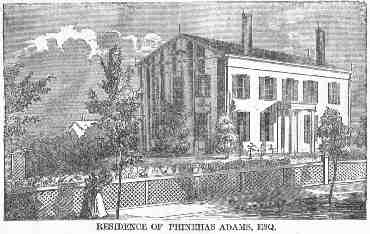
built the house for the Agent of the Stark Mill; now occupied by Phinehas Adams; on 112 was a story and a half wooden shop; on 113, D. A. Bunton, built the two story house owned by E. W. Harrington; on 134, the Amoskeag Manufacturing Company built the house now owned by Charles Richardson, Esq.; and on Lot 135, the First Congregational Society built the Hanover Street Church.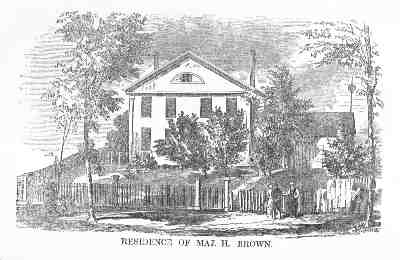 Water streets, occupied by Cyrus W. Baldwin and A. M. Chapin, Esqrs.; which house was moved upon Bridge street opposite Tremont Square, and a second story added to it by Mr. Charles Clough, by whom it is now owned; a second house known as the "Gamble House" which stood [sic stood?] near the east end of the old Amoskeag Bridge, upon the old river road, just south of its junction with the Derry road, and which was moved upon North Chestnut street, and now belongs to the heirs of the late J. B. Congdon; two small houses near the Gamble house one north and the other south of it, and both upon the old river road, the one north of the Gamble house having been burned a few years since, and the one south of it having been moved upon the corner of Lowell and Chestnut streets, and owned by Mr. Jacob Peavy; a fifth house, situated upon what is now called Orange street, a little west of north Chestnut street, belonging to the heirs of the late Samuel P. Kidder, and torn down when Orange street was graded; and a sixth house known as the "Barren House" which stood on Granite street, just opposite the Freight Depot of the Concord Railroad, and which now stands at the corner of Granite and Union streets.
And now, a more particular discription of the various manufacturing departments, connected with what is known as the Corporations, will be given. And first of the
- The Real Estate and Building department. Of this department Robert Read, Esq, was Agent until January 1852, when E. A. Straw, Esq., the present efficient Engineer of the Company, succeeded him. This department has the general superintendence of surveys, sales of land, building factories, boarding houses, &c. The Clerk is Joseph Knowlton, Esq.
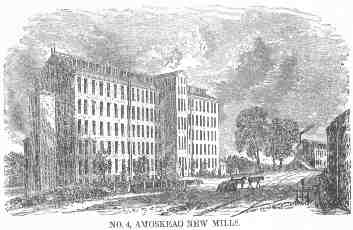
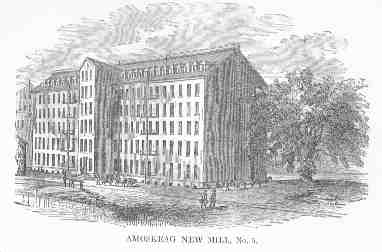
- The Amoskeag New Mills, consisting of five mills, numbered 1, 2, 3, 4 and 5. David Gillis, Esq., is Agent of this department, and Charles Richardson. Esq., was Clerk, until 1854, when he was succeeded by Charles L. Richardson, who continues as clerk at the present time.
- The Machine Shop. This department includes the old and new Foundries, Boiler Shop, Forge Shop, Tank Shop, Paint Shop, Pattern house, and Storehouse. Cyrus W. Baldwin Esq., is the Agent, and Justus D. Watson, is Clerk.
- This department includes the Hooksett Factory, eight miles up the river, at Hooksett, engaged in the Manufacture of Mouslin de Laines; runs 8000 spindles, and is under the Superintendence of Stephen Ballard.
- This department includes the mills and real estate at Amoskeag Village, in Goffstown; since the burning of the Bell mill in 1847, but little business has been done at this place. A mill for the manufacture of Batting is kept in operation, but the buildings, including counting room, and most of the boarding houses, have been rented to Boyd, & Corey, who are extensively engaged in the manufacture of shoes.
MACHINE SHOP.
The machine Shop of the Amoskeag company, unpretending in appearance; and entirely out of sight of all passers by, and others even, unless led to enter its yard upon business, or from curiosity, formerly attracted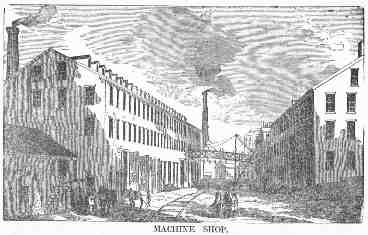 little attention, it being merely an appendage to the company's factory operations. Yet it ever has been an establishment of importance, using immense quantities of raw material, turning off a great amount of machinery, and giving employment to a large number of workmen; and now has not only become a most important part of the Amoskeag company's establishment, but has gained a world wide reputation for the excellency of its machinery.
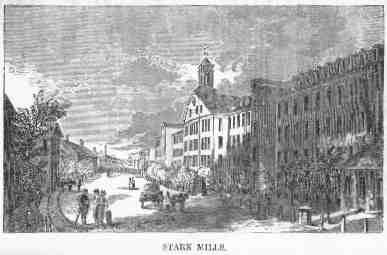
THE STARK MILLS.
The corporation known as "The Stark Mills," was incorporated in 1838, with a capital of $1,000,000, and was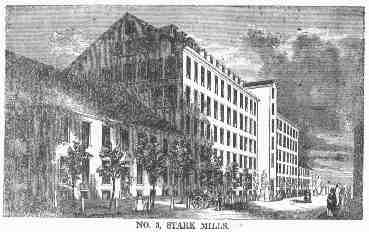 organized by the choice of
NATHAN APPLETON, President,This company put the first Cotton Mill in operation on the east side of the Merrimack in this city. This Mill was built for them by the Amoskeag Manufacturing Company, in the Summer and Fall of 1838, the machinery for the same having been built in Lowell. It went into operation the first of 1839, John A. Burnham, Esq., taking the charge of the same as Agent in January 1839. This mill was 4 stories high, 48 ft. wide, by 157 long. was situated upon the upper canal, and contained 8000 spindles, and constitutes the south wing of what is now known as "Stark Mills No. 1."
WM. AMORY, Treasurer,
GEO. W. KIMBALL, Clerk.
NATHAN APPLETON, }
GEO. W. LYMAN, }
WILLARD SAYLES, }
FRANCIS C. LOWELL, }
WM. APPLETON, }
WM. AMORY, }
SAMUEL HENSHAW, }Directors.
In No. 1 Mill, 21400 spindles, andManufacturing 17,000,000 yards of sheetings and drillings per annum.
662 looms upon sheetings, and drillings.
In No. 2 Mill, 19564 spindles, and
560 looms upon sheetings and drillings,
 are known as "Seamless bags," and are the best article of the kind in the market.
In No. 1 Mill, 51420 spindles, andOn the 1st day of July, 1853, Geo. W. Tilden, Esq., resigned the office of Pay Master, to this corporation, having held the office since June 1839, fourteen years and one month. Mr. Tilden was succeeded in his office by William B. Webster Esq.
300 looms for sheetings drillings and ducks.
260 looms for bags.
In No. 2 Mill, 19564 spindles, and
550 looms upon sheetings and drillings.
They manufacture Sheetings, Drilling; Ducks and Bags
They employ 200 males, and 950 females.
Number of Tenements, 66.
Pay at the mills, $30,000 per month.
Consume annually 1,000,000 cubic feet of Gas.
5,880 gallons of Oil.
75 tons of Starch.
1000 tons of Coal.
6,000,000 lbs of Cotton.
Manufacture annually 2,080,000 (2 bush.) bags.
" " 8,000,000 yds sheeting.
and drillings.
NATHAN APPLETON, President.The Stark Mills are under most excellent management, their affairs are conducted in a quiet manner, and in spite of disaster, they are doing a lucrative business, their goods commanding ready sales, and their stock standing well on 'change.
WM. AMORY, Treasurer.
PHINEHAS ADAMS, Clerk
NATHAN APPLETON, }
SAMUEL FROTHINGHAM,}
DAVID SEARS, }
WM. APPLETON, }
WM. AMORY, }
GEO, W. LYMAN, }
FRANKLIN H. STORY. }Directors.
AMOSKEAG NEW MILLS.
The department of the Amoskeag Manufacturing Company, devoted exclusively to the manufacture of cotton goods, has become one of great importance, although in the incipient stages of the company, their operations in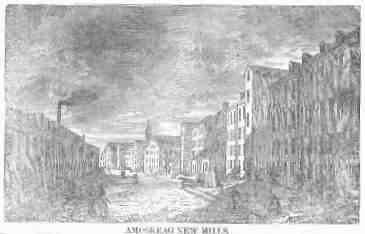 real estate, in the manufacture of machinery, and in preparations for other companies seem to have overshadowed this department. Still, however, this, the primary object of the company, has been all the while making steady, and permanent progress. And it is understood, that this department, now including five large mills, has been built entirely from the earnings of the company, besides occasional handsome dividends.
| No. 1 | contains | 8960 | spindles, | and | 234 | looms. |
| " 2 | " | 8832 | " | " | 250 | " |
| " 3 | " | 20478 | " | " | 545 | " |
| " 4 | " | 24576 | " | " | 636 | " |
| " 5 | " | 20000 | " | " | 480 | " |
| Total, | ||||||
| 82846 | 2345 |
 67,000 daily, equal to 38 miles per day, consisting of
Tickings, various qualities.There are 109 Tenements used for boarding houses, and overseers, tenements.
Denims.
Mariner's Stripe.
Drillings, various qualities.
Sheetings.
Flannels.
No. of Females employed, 2500
No. of Males, 700
Amount paid out at Mills, $40,000 per month.
 A Savings Bank is connected with these mills for the benefit of those employed by the Company; amount on deposit, 164,000,00 interest at the rate of 5 per ct.
9000 galls. of oil. Gas is introduced throughout the mills.At the World's Fair, of 1851, holden in London, the Amoskeag Manufacturing Company, placed on exhibition samples of the goods manufactured by them, consisting of Sheetings, Drillings, Cotton Flannels and Tickings. This was literally, "carrying coals to New Castle." Thus exposing their fabricks [sic] in the great commercial mart of manufacturing England, and asking comparison of material and manufacture, savored somewhat of presumption; but going upon the principle so briefly set forth by Patch, the Yankee diver, "that some things can be done as well as others," this Yankee company did it, and challenged comparison of their fabrics, with those of Europe. The Jurors who were to make the comparison were one half Englishmen, and the other half from different nations in Europe, except one alone from the United States. The Jury thus constituted, awarded the Prize medal of the Exhibition to the "Amoskeag Manufacturing Company," for the best articles in class 11, at the World's Fair, and they awarded no other medal to Exhibitors in that class. This is a high but well merited honor.
350,000 lbs of Starch. 150,000 lbs, of Drugs.
5000 Cords of Wood
1000 tons of Coal,
3000 bush. Charcoal.
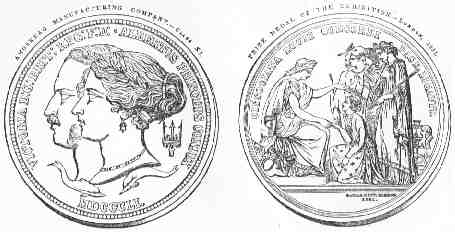 their drapery, are two dolphins, emblematic of the mutual love of the royal pair; while in the rear is the trident of Neptune, shadowing forth that England claims to be mistress of the seas, but evidently with its handle broken, doubtless prophetic of the about to be established fact, that if "Brittannia rules the waves;" "America" would
"---walk the waters like a thing of life,"
and come out winner as against the world!MANCHESTER PRINT WORKS.
This establishment includes mills for the manufacture of Mouslin de Laines, and Print Cloths, and Print Works for printing these manufactures.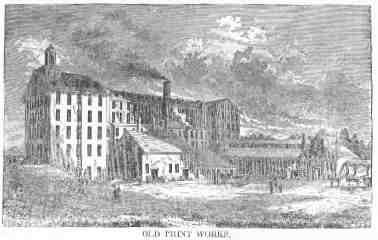 stock of $1,000,000. In 1847, this corporation became merged in one under the name of "Merrimack Mills," with a capital stock of $1,500,000. This change took place under the impression that the charter of the "Merrimack Mills," was more liberal in its provisions. But in 1851, the name was altered by an act of Legislature to "Manchester Print Works," and again in 1852, its capital was increased to $1,800,000.
| Males, | 300 |
| Females, | 800 |
| Number of Tenements, | 62 |
| Pay annually for labor, | $220,000 |
| Consume annually lbs. of Cotton, | 1,144,000 |
| " " " Wool, | 1,300,000 |
| " " " cords of Wood, | 2,700 |
| " " " lbs. of Starch, | 1,000,000 |
| " " " Oil Soap, | 72,000 |
| " " tons of Coal, | 400 |
| " " galls. of Olive Oil, | 11,000 |
| " " " Sperm Oil, | 6,000 |
| " " cubic feet of Gas, | 1,192,200 |
| Manufacture " yd's of Cloth, | 14,000,000 |
| " daily " " | 45,000 |
HANDS EMPLOYED.
| Males, | 400 |
| Females, | 30 |
| Paid out annually for Drugs, | $375,000 |
| PayRoll, | 180,000 |
| Fuel, | 30,000 |
| 10 Printing Machines. | |
| Printed Annually De Laines, | 13,000,000 yd's |
| Daily | 37,500 " |
| Annually Cottons, | 3,462,678 " |
| Daily, | 12,000 " |
| No. of Tenements, 36. |
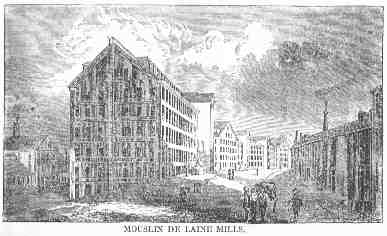 calicoes, &c. The ordinary production of the works is,
HANDS EMPLOYED.
Males, 750OLIVER DEAN, President.
CHARLES AMORY, Treasurer.
J. S. SHANNON, Clerk.
OLIVER DEAN, }
DAVID SEARS, }
J. C. HOWE, }
GEORGE HOWE, }
NATHAN APPLETON, }
WM. AMORY, }
S. R. PAYSON. }Directors.





 Chapter 23
History of Manchester
Hillsborough County
ALHN-New Hampshire
Created May 11, 2001
Copyright 2000, 2001